How Much Protein per Meal? A Practical Meal-by-Meal Guide
Divide an appropriate daily protein target across meals you enjoy. See flexible examples, weighed food portions, and what the 30 g myth gets wrong.
The short answer
Start with an appropriate daily protein target, then share it across the meals and optional snacks you actually eat. For illustration, 100 g across three meals could be 30 + 35 + 35 g; across three meals and a snack it could be 20 + 30 + 30 + 20 g. These are planning examples, not personal recommendations. Your needs depend on age, activity, goals, and health; 30 g is not a hard absorption ceiling.
Begin with your daily needs, not a universal meal target
Protein needs vary with body size, activity, age, and health. NIH’s athlete guidance discusses 1.2–2.0 g/kg/day for training and recovery, not a default prescription for every adult. Endurance and resistance-training demands differ.
ESPEN’s geriatric guideline recommends at least 1 g/kg/day for older adults, adjusted for nutritional status, activity, illness, and tolerance. Kidney disease and other conditions affecting protein needs require individualized advice from a clinician or registered dietitian.
Vitalo’s protein calculator uses weight and an activity/goal category to estimate a daily range and show four equal shares. It does not select foods, assess medical history, or create a meal plan.
Use five simple steps to plan protein across meals
Count the meals and snacks you actually eat, rather than designing a difficult schedule. A snack is an option, not a requirement.
- Establish an appropriate daily target or range, with professional input when needed.
- Count realistic meals and any snack you genuinely want.
- Divide the daily amount into a flexible starting pattern; equal shares are just convenient arithmetic.
- Check actual portions using package labels or matching food database entries.
- Adjust the distribution to appetite, preferences, preparation time, and routine.
How to split 90 g, 100 g, or 120 g across meals
These are arithmetic examples, not recommendations for your body weight or goals. Every row adds up. Meals need not have identical amounts; a snack pattern need not provide more protein than three meals.
For 100 g, four equal shares average 25 g. The flexible 20 + 30 + 30 + 20 g example also totals 100 g. Choose a pattern you can repeat.
Swipe or scroll the table to see all columns.| Daily total | Eating pattern | Breakfast | Lunch | Dinner | Snack |
|---|---|---|---|---|---|
| 90 g | Three meals | 25 g | 30 g | 35 g | 0 g |
| 90 g | Meals + snack | 20 g | 25 g | 30 g | 15 g |
| 100 g | Three meals | 30 g | 35 g | 35 g | 0 g |
| 100 g | Meals + snack | 20 g | 30 g | 30 g | 20 g |
| 120 g | Three meals | 35 g | 40 g | 45 g | 0 g |
| 120 g | Meals + snack | 30 g | 35 g | 35 g | 20 g |
Check food weight and protein grams separately
A 100 g portion of food does not mean 100 g of protein. A label may show values per serving or per 100 g. If a yogurt lists 10 g protein per 100 g and you eat 150 g, it provides about 15 g. If the label states values per pot, use the pot size to avoid multiplying twice.
Choose a database entry that matches the food and preparation. Dry lentils and cooked lentils have different values per 100 g because cooking changes water content. Weigh edible portions: remove banana peel and chicken bones, and use the stated preparation for rice, tofu, or beans.
A weighed example day: about 100 g before an optional snack
This example illustrates portions, not a nutritionally complete or personalized meal plan. Add or adapt foods to suit your energy needs and wider diet. The table counts every listed ingredient; any additions need their own estimate.
Food values come from the specific USDA SR Legacy records linked below. Brands and preparation methods affect the estimates; use your product label when available.
For readable meal totals, each ingredient’s protein is rounded to the nearest whole gram before adding. For example, 90 g cooked chicken gives 90 × 31.02 ÷ 100 = 27.918 g, shown as 28 g. The displayed meal and daily totals sum those rounded values; they are estimates, not exact measurements.
| Meal | Foods and weighed portions | Protein |
|---|---|---|
| Breakfast | 200 g plain lowfat Greek yogurt (20 g) + 40 g uncooked oats (7 g) + 100 g peeled raw banana (1 g) | 28 g |
| Lunch | 90 g roasted chicken breast, cooked edible meat (28 g) + 150 g cooked enriched long-grain white rice (4 g) + 100 g raw edible broccoli (3 g) | 35 g |
| Dinner | 150 g boiled lentils without salt, cooked edible weight (14 g) + 100 g uncooked calcium-set firm tofu, without packing liquid (17 g) + 100 g cooked rice (3 g) + 100 g raw edible broccoli (3 g) | 37 g |
| Three-meal total | Breakfast + lunch + dinner | 100 g |
| Optional snack | 20 g almonds | 4 g |
| Total with snack | Three meals + almonds | 104 g |
Make plant-based swaps using their own values
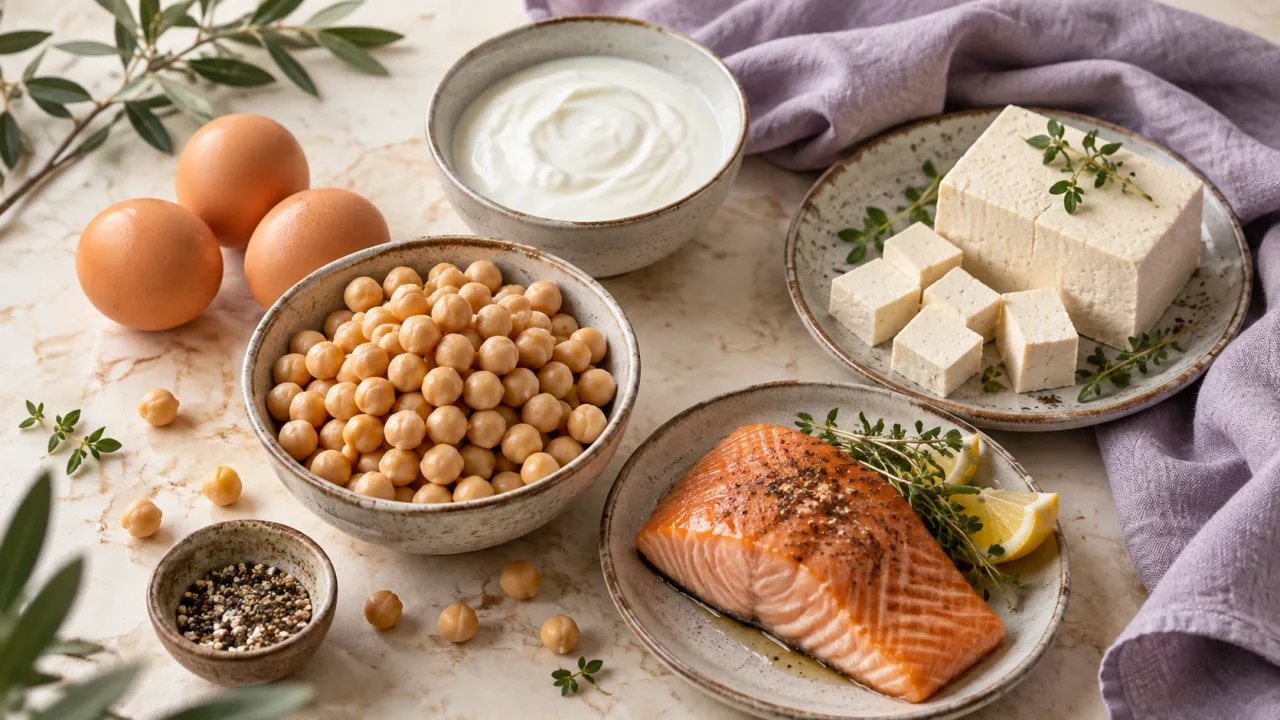
Build from foods you already eat: beans, lentils, tofu, soybeans, dairy foods, eggs, fish, or poultry. Do not assume equal food weights provide equal protein. These plant options have been calculated separately using the specified USDA entries.
Replacing lunch’s 90 g cooked chicken with 150 g of this firm tofu provides about 26 g protein instead of 28 g; with the same rice and broccoli, lunch becomes about 33 g rather than 35 g. A 200 g serving of cooked lentils provides about 18 g, not 28 g. Check your tofu or plant-yogurt label: brands can differ substantially.
Swipe or scroll the table to see all columns.| Plant food and state | Protein per 100 g | Example portion | Approximate protein |
|---|---|---|---|
| Firm calcium-set tofu, uncooked, packing liquid excluded | 17.27 g | 150 g | 26 g |
| Lentils, boiled without salt, cooked weight | 9.02 g | 200 g | 18 g |
| Edamame, prepared from frozen, edible shelled portion | 11.91 g | 150 g | 18 g |
Can your body absorb more than 30 g of protein?
Yes. Digestion and absorption are not the same as muscle protein synthesis. Digestion breaks protein into smaller components; absorption moves them from the intestine into circulation. Muscle protein synthesis is the making of muscle proteins. Long-term muscle growth is a separate outcome measured over repeated training and recovery, not one meal.
In a 2023 randomized study, 36 healthy, recreationally active young men received 0, 25, or 100 g milk protein after whole-body resistance exercise. Researchers tracked responses for 12 hours. The 100 g dose produced a larger and longer protein-synthesis response than 25 g under those conditions.
That finding contradicts a universal 30 g absorption ceiling. It does not establish 100 g as an ideal meal dose, compare every possible meal schedule, or prove greater muscle growth over months. It also cannot automatically be applied to older adults, women, or people with medical conditions. Protein above 30 g is not automatically wasted.
What does spreading protein throughout the day achieve?
Distribution is a useful planning tool, but evidence does not justify promising that perfectly equal meals improve everyone’s results. In a small 2014 crossover trial of eight healthy adults, an even pattern of roughly 30 g at each meal increased 24-hour muscle protein synthesis compared with a dinner-heavy pattern. That measured a short-term response, not long-term muscle growth.
In a 2024 trial, 43 women aged 20–44 with overweight or obesity completed a 16-week weight-loss intervention. At a fixed protein intake, even versus dinner-heavy distribution did not significantly change body-composition outcomes between groups. This does not settle every training question; it shows why the population and outcome matter.
Meet an appropriate daily amount first, include protein in meals you enjoy, and adjust a consistently low-protein meal if useful. An exact timetable or perfectly equal servings is not a requirement established for everyone.
Solve the obstacle that actually affects your day
Start with one change rather than rebuilding every meal. Notice where the plan becomes inconvenient, then make that part easier.
- Very little at breakfast: keep the meal you like and add a suitable protein food, such as yogurt, eggs, tofu, or prepared edamame. Check its actual portion.
- Most protein at dinner: move a portion to lunch or use it as leftovers; you do not need to label dinner’s protein as wasted.
- Fewer meals suit you: larger portions can still contribute to daily needs. If they feel uncomfortable or hard to prepare, consider a snack instead.
- Plant-based meals: choose a deliberate protein source and compare labels rather than assuming plant milks, yogurts, beans, and tofu are interchangeable.
- No protein powder: ordinary foods can supply protein. A powder is a convenience option, not a requirement for this method.
Find the protein in homemade dishes
For a homemade dish, calculate the ingredients’ protein and the number of servings. The linked recipe guide explains that process without assuming raw and cooked weights are interchangeable.
Once you already know the whole-recipe nutrition totals, Vitalo’s recipe nutrition calculator divides them into equal servings. It does not look up ingredients, add their nutrition, or calculate unequal portions from cooked weight. Save a repeatable version and revise it when ingredients or portions change.
Choose a useful next step, not a perfect score
For a meal idea, Vitalo’s Tuna White Bean Salad combines drained tuna, beans, and vegetables. The recipe currently lists three servings and an estimated 30 g protein per serving. Treat that as the recipe’s estimate: can sizes, drained weights, and brands still matter.
Keep the routine practical
If you already have a suitable calorie target, the macro calculator converts your chosen protein and fat percentages into grams and assigns the remaining percentage to carbohydrate. It does not determine whether that target or split suits you.
Return to one familiar meal, check its portion, and adjust only if useful. If tracking would help, check Vitalo’s download page for current app availability. The website’s free calculators work without an account.
Put it into practice
A useful next step
Frequently asked questions
How much protein should I eat at each meal?
Divide an appropriate daily amount across realistic meals. For illustration, 100 g can become 30 + 35 + 35 g; that daily total is not suitable for everyone.
Is 30 g of protein per meal enough?
It depends on daily needs and the rest of the day. Three 30 g meals total 90 g, not 120 g. There is no universal meal target.
Can I absorb more than 30 g of protein at once?
Yes. Absorption and muscle protein synthesis are different. The acute larger-dose study above challenges a fixed ceiling, but does not establish an ideal long-term meal schedule.
Do I need protein at breakfast?
Breakfast is a convenient opportunity, especially if you struggle later in the day. Add a food you enjoy; breakfast does not need to match dinner exactly.
Can I meet my protein needs with three meals?
Yes, if those meals provide your appropriate daily amount. A snack may help with appetite or convenience, but it is not mandatory.
Do I need protein powder?
No. Ordinary foods can contribute enough protein. Check portions and the wider diet; a supplement is optional and should fit individual needs.
Sources & further reading
- 1.NIH Office of Dietary Supplements: Protein, exercise, and athletic performance
- 2.USDA FoodData Central: Food composition database
- 3.Trommelen et al., 2023: Acute responses to 25 g and 100 g protein after exercise
- 4.Mamerow et al., 2014: Protein distribution and 24-hour muscle protein synthesis
- 5.De Leon et al., 2024: Protein distribution during a 16-week weight-loss trial
- 6.ESPEN, 2022: Practical guideline on clinical nutrition and hydration in geriatrics
- 7.USDA SR Legacy, FDC 170903: Greek yogurt, plain, lowfat
- 8.USDA SR Legacy, FDC 169705: Oats, uncooked
- 9.USDA SR Legacy, FDC 173944: Bananas, raw
- 10.USDA SR Legacy, FDC 171477: Chicken breast, meat only, cooked, roasted
- 11.USDA SR Legacy, FDC 168878: Enriched long-grain white rice, cooked
- 12.USDA SR Legacy, FDC 170379: Broccoli, raw
- 13.USDA SR Legacy, FDC 172421: Lentils, cooked, boiled, without salt
- 14.USDA SR Legacy, FDC 172475: Firm tofu, raw, prepared with calcium sulfate
- 15.USDA SR Legacy, FDC 170567: Almonds
- 16.USDA SR Legacy, FDC 168411: Edamame, frozen, prepared
About the author
Vitalo Editorial
Vitalo Editorial creates practical guides to food, habits, and body measurements. Articles connect published health resources with worked examples and Vitalo tools. These guides provide general education; individual articles name a clinical reviewer only when an actual qualified review has taken place.
Read our editorial policy →