Goal 1
Muscle maintenance
1.2–1.6 g/kg/day
Stay active. Support the muscle you have.
A practical starting range for healthy, active adults focused on maintaining muscle rather than prioritizing muscle gain. Keep resistance exercise in your routine.
Know your range—not just a single number.
Quick answer
Compare daily protein for muscle maintenance (1.2–1.6 g/kg), building muscle (1.4–2.0 g/kg), and athletes or bodybuilders (1.6–2.2 g/kg). These overlapping planning ranges are for healthy, active adults—not three guaranteed levels of muscle growth.
Your result
Add your details and calculate to see an estimate with a clear explanation and useful supporting numbers.
Choose for your training
These are Vitalo’s practical planning bands for healthy, active adults, informed by the sources below—not three official thresholds. Their overlap is intentional. Start with the goal that matches your routine.
Goal 1
1.2–1.6 g/kg/day
Stay active. Support the muscle you have.
A practical starting range for healthy, active adults focused on maintaining muscle rather than prioritizing muscle gain. Keep resistance exercise in your routine.
Goal 2
1.4–2 g/kg/day
For regular, progressive strength training.
For recreational lifters working to build muscle. Pair protein with progressive resistance training, enough total energy, and recovery; extra protein alone does not build muscle.
Goal 3
1.6–2.2 g/kg/day
A wider range for demanding training.
For experienced lifters and athletes planning around demanding training. The upper end offers a planning margin for individual variation, not a requirement for every athlete or a guarantee of faster growth.
Think consistent training, enough food, and good recovery—not “maximum protein.” Competitive bodybuilding or weight cutting deserves an individualized sports-nutrition plan.
How it works
Convert pounds to kilograms if needed, then multiply body weight in kilograms by the two factors for your selected goal. For example, a 95 kg adult selecting Build muscle sees 133–190 g/day (95 × 1.4 to 95 × 2.0). All protein from food and drinks counts. The four-meal split is an optional planning example, not an absorption limit.
Source: NIH protein overviewKeep in mind
These are practical overlapping ranges, not separate biological thresholds or a personalized prescription. Athletes can build muscle within the middle range. Kidney disease, pregnancy, breastfeeding, or other medical needs require individualized guidance; this tool is not designed for children. During a calorie deficit or at a high body-fat level, ask a sports dietitian about an appropriate weight basis and target.
Vitalo tools provide general education, not medical advice, diagnosis, or treatment.
Clear answers
Convert pounds to kilograms if needed, then multiply body weight in kilograms by the two factors for your selected goal. For example, a 95 kg adult selecting Build muscle sees 133–190 g/day (95 × 1.4 to 95 × 2.0). All protein from food and drinks counts. The four-meal split is an optional planning example, not an absorption limit.
These are practical overlapping ranges, not separate biological thresholds or a personalized prescription. Athletes can build muscle within the middle range. Kidney disease, pregnancy, breastfeeding, or other medical needs require individualized guidance; this tool is not designed for children. During a calorie deficit or at a high body-fat level, ask a sports dietitian about an appropriate weight basis and target.
No. This free tool provides a general educational estimate and cannot diagnose a condition or replace advice from a qualified healthcare professional.
Not necessarily. A resistance-training meta-analysis found an average plateau in additional lean-mass gains at about 1.6 g/kg/day, with uncertainty between individuals. The 2.2 g/kg upper end is a planning margin, not a proven better target for everyone. Training, energy intake, and recovery still matter.
Maintenance, muscle gain, and athletic training do not have sharp protein boundaries. Vitalo groups broader sports-nutrition evidence into practical planning bands. Choose for your training demands, not because the highest option sounds best.
No. Food can meet your target, and powder is optional. Spread protein across meals in a pattern you can sustain. The four-meal example divides your daily total equally; it is not a mandatory schedule or a limit on how much protein you can absorb.
Vitalo journal
Anabolic steroids can increase muscle size, but that does not establish safety. Understand the health risks, what recovery evidence actually shows, and how to discuss use without judgement.
If you train regularly but cannot see muscle growth, review the evidence in your training log, meals and recovery. Seven practical checks can help you choose a useful next step.
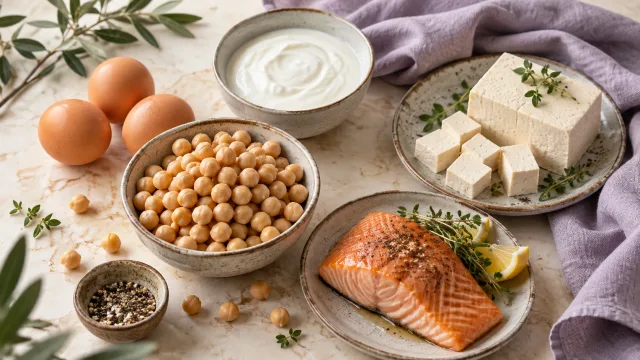
Divide an appropriate daily protein target across meals you enjoy. See flexible examples, weighed food portions, and what the 30 g myth gets wrong.
Keep exploring
Keep the rhythm going
Track meals, hydration, habits, mood, and body progress together in Vitalo.