Iranian Food: 10 Persian Dishes to Discover and Cook
Fragrant rice, herb-rich stews and smoky eggplant: find your next Iranian dish, then open the recipe in English, Persian or Arabic.
The short answer
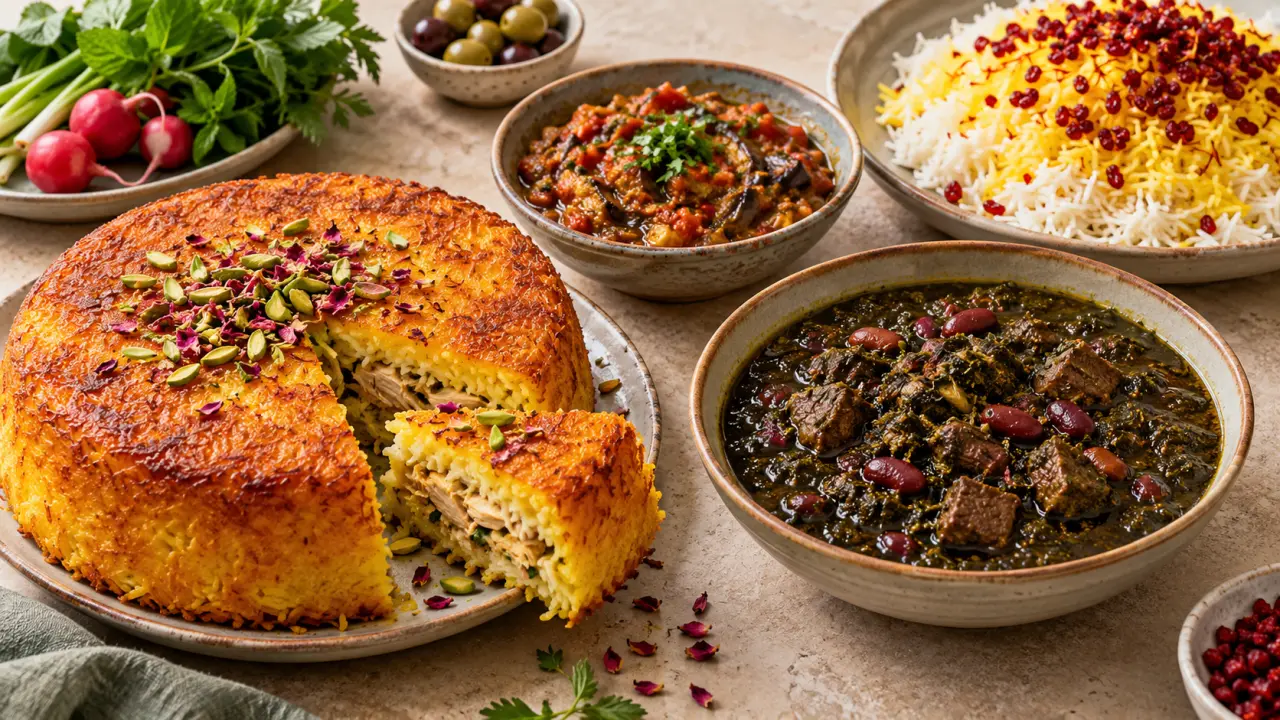
Start with what you enjoy: ghormeh sabzi for herbs and dried lime, fesenjan for walnuts and pomegranate, tahchin for golden rice, or mirza ghasemi for smoky eggplant. This selection introduces ten dishes; it is not a ranking or a complete map of Iran’s regional cooking.
A first taste of Iranian food
Iranian food, often called Persian food in English, is much more than a kebab plate. This guide moves between rice dishes, stews, a herb-and-noodle soup and two eggplant dishes. It is a practical starting point, not a claim that one menu represents every community or region.
Each dish below links to Vitalo’s own recipe version. The external references provide culinary context; they are not endorsements of Vitalo or the source of its nutrition estimates. Families and cooks make these dishes differently, so the linked ingredient list is the guide to the version you will actually cook.
1. Ghormeh sabzi: herbs, beans and dried lime
Choose ghormeh sabzi when you want a herb-forward stew with a sour edge. Vitalo’s version combines beef, kidney beans and dried lime. Its rice is a separate accompaniment, so read the serving note before treating the stew and a full rice plate as the same portion.
2. Fesenjan: walnut and pomegranate richness
Fesenjan brings ground walnuts and pomegranate molasses into a deep, rich sauce. Tartness and sweetness vary with the molasses and the cook’s preference. Vitalo’s version uses chicken; open the recipe for its quantities rather than assuming that every fesenjan uses the same meat or balance.
Explore the chicken fesenjan recipe
3. Gheimeh: split peas, tomato and a potato topping
Gheimeh, also written gheymeh, is a different direction from the herb-heavy stews: tomato, yellow split peas and dried lime give it its character. The Vitalo recipe uses beef and oven-cooked potato strips. Rice is not included in that recipe’s nutrition estimate.
See the gheimeh recipe and ingredients
4. Zereshk polo ba morgh: barberry rice with chicken
Small barberries add a tart contrast to saffron rice in zereshk polo ba morgh. Chicken makes the plate a meal rather than a rice side. Vitalo’s version counts both components in the stated serving; this is useful when comparing it with a stew recipe that excludes rice.
5. Kabab koobideh: minced-meat kebabs with rice
Koobideh is made from seasoned minced meat, rather than cubes of meat threaded onto a skewer. Vitalo’s beef version pairs it with saffron rice and tomatoes. Follow the recipe’s handling and doneness directions; a browned surface alone does not tell you what is happening at the centre.
Open the kabab koobideh recipe
6. Tahchin morgh: golden rice with a chicken centre
Tahchin is a good choice when texture is part of the appeal: a golden exterior gives way to rice and a chicken filling. Yogurt, egg and saffron are part of Vitalo’s rice mixture. It is cut into portions, so check the yield rather than comparing a whole slice with a spoonful of plain rice.
Discover the tahchin morgh recipe
7. Baghali polo ba goosht: dill rice, broad beans and lamb
For another rice-led meal, baghali polo combines broad beans and dill. “Ba goosht” means it comes with meat; the Vitalo version uses slow-braised boneless lamb. Rice, beans and meat are all included in its complete-plate serving, rather than listed as optional extras.
8. Ash reshteh: a bowl of herbs, legumes and noodles
Ash reshteh is a thick soup, not a rice-and-stew plate. Vitalo’s version includes cooked legumes, wheat noodles and kashk, with toppings shared between the bowls. It contains wheat and milk; meat-free does not automatically mean vegan or suitable for every dietary restriction.
Explore the ash reshteh recipe
9. Kashk bademjan: eggplant with a tangy dairy finish
Kashk bademjan brings soft eggplant together with kashk, a tangy dairy ingredient. Vitalo’s version also includes onion, mint and walnuts. It is portioned as a starter and excludes bread from its estimate; adding bread changes the meal you are putting on the table.
Open the kashk bademjan recipe
10. Mirza ghasemi: smoky eggplant, tomato and eggs
Associated with Gilan in northern Iran, mirza ghasemi is an inviting place to start if you enjoy smoky vegetables. Eggplant, tomato, garlic and eggs are central to the Vitalo version. It is meat-free but not vegan, and bread or rice remains a separate accompaniment.
Which Iranian dish should you try first?
Pick by flavour rather than by a “best food” ranking: dried-lime and herb notes suggest ghormeh sabzi; walnut and pomegranate suggest fesenjan; smoky eggplant suggests mirza ghasemi. Choose tahchin when you want a sliced rice centrepiece, or ash reshteh when you want a spoonable meal. These are suggestions for navigating this collection, not dietary prescriptions.
Before shopping, open the linked recipe, check the number of servings and read all the steps. Notice whether rice, bread, oil and toppings belong to the recipe or are extra. For allergies, check the complete ingredients and the labels on products such as kashk and noodles.
Use the recipes, and keep their estimates in context
Vitalo’s recipe pages show ingredients, steps and estimated nutrition. Those figures are not laboratory measurements or independently verified nutrition calculations. Your ingredients, portions and accompaniments can change the result. This article introduces food and flavour; it does not make a health claim or certify the recipes as kitchen-tested.
Sources & further reading
- 1.Encyclopaedia Iranica — Principles and ingredients of modern Persian cooking
- 2.Encyclopaedia Iranica — Ḵoreš, by Etrat Elahi
- 3.Homa, Persian Mama — Ghormeh Sabzi
- 4.Homa, Persian Mama — Fesenjan
- 5.Homa, Persian Mama — Gheymeh
- 6.Homa, Persian Mama — Zereshk Polo ba Morgh
- 7.Homa, Persian Mama — Kabob Koobideh
- 8.Homa, Persian Mama — Tahchin Morgh
- 9.Homa, Persian Mama — Aash Reshteh
- 10.Homa, Persian Mama — Kashke Bademjan
- 11.Homa, Persian Mama — Mirza Ghasemi
- 12.Encyclopaedia Iranica — Āšpazī, by Bert G. Fragner
About the author
Vitalo Editorial
Vitalo Editorial creates practical guides to food, habits, and body measurements. Articles connect published health resources with worked examples and Vitalo tools. These guides provide general education; individual articles name a clinical reviewer only when an actual qualified review has taken place.
Read our editorial policy →