Arabic Food: 10 Popular Dishes to Discover and Cook
From lemony mezze to spiced rice and chicken: discover ten Arabic favourites, their flavours, portions and recipes in three languages.
The short answer
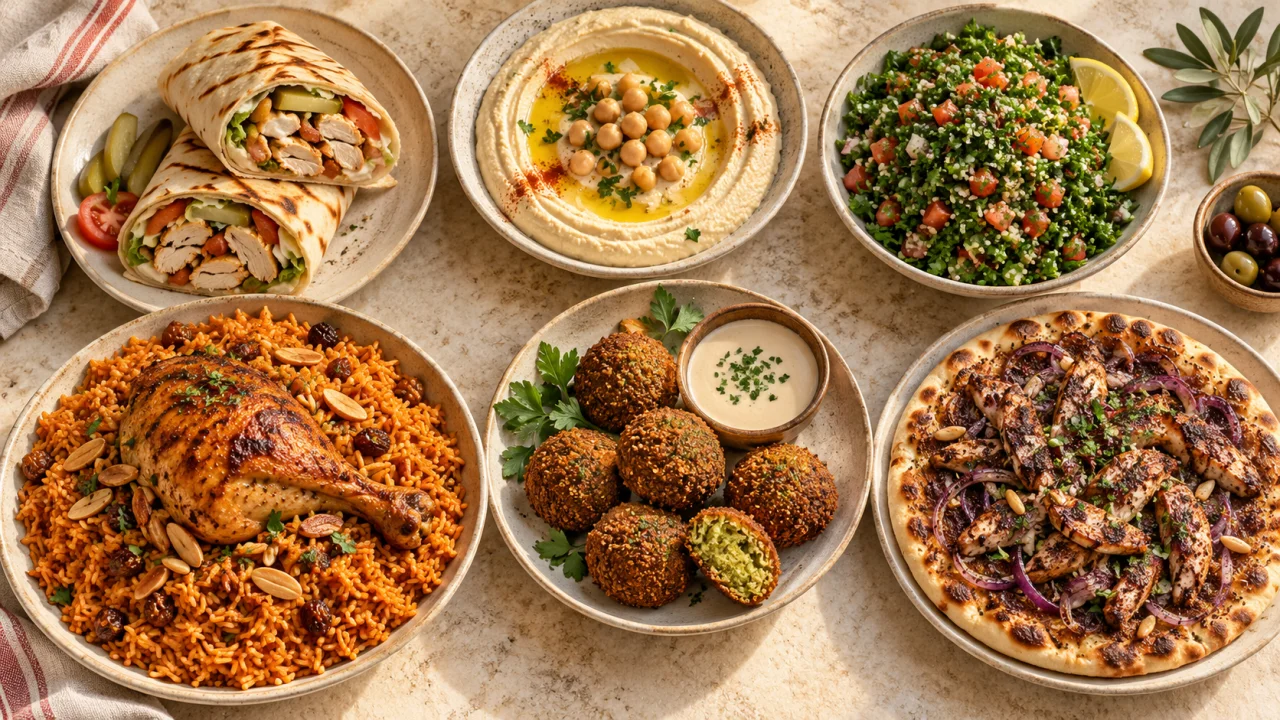
Start with shawarma or shish tawook for chicken, hummus and baked falafel for chickpeas, tabbouleh or fattoush for fresh sides, kabsa or maqluba for rice, koshari for an Egyptian bowl, or musakhan for sumac-onion flatbread. Each link includes its own serving definition and nutrition estimate.
A table of Arabic favourites
Arabic food spans many regional kitchens. Here we move from Levantine mezze and chicken grills to Egyptian koshari, Gulf-style kabsa and Palestinian musakhan. Lemon, herbs, chickpeas and warm spices connect some dishes, but each has its own texture and place at the table.
These are ten popular starting points, not a ranked list of the Arab world’s ten most searched foods. As one recent signal, Deliveroo’s 2025 Kuwait list included shawarma, falafel sandwiches and chicken majbous or machboos. That is delivery data for one market and period; it does not establish a 2026 ranking for every dish here. We also chose familiar mezze and regional staples to give the collection variety.
Each link opens Vitalo’s own home adaptation, with ingredients and steps in English, Arabic and Persian. External culinary references informed our research; they do not endorse Vitalo’s formulations or nutrition calculations. Baked falafel, roasted maqluba vegetables and oven-crisped koshari onions are adaptations, clearly identified in the recipes.
1. Chicken Shawarma Wrap with Yogurt Garlic Sauce
Shawarma is associated with thinly sliced, richly seasoned meat; the home version uses a pan instead of a vertical spit. Vitalo uses chicken breast and a yogurt-garlic sauce. Its serving is a complete wrap: chicken, a 60 g pita, vegetables and sauce. It contains wheat and milk; fries and pickles would be extra.
2. Shish Tawook — Yogurt-Marinated Chicken Skewers
Choose shish tawook for chicken skewers scented with yogurt, garlic and lemon. The four-hour refrigerated marinade is part of planning, even though grilling is quick. The estimate covers one quarter of the chicken and all listed marinade, while bread, rice and toum remain separate. The yogurt contains milk.
Open the recipe and ingredients
3. Hummus — Chickpea and Tahini Dip
Hummus blends cooked chickpeas, tahini, lemon and garlic into a smooth dip. Weigh chickpeas after cooking and draining; the same weight of dried chickpeas would make a very different batch. Vitalo divides the hummus into six portions, including the olive-oil topping. It contains sesame, and bread is not part of the estimate.
Open the recipe and ingredients
4. Baked Falafel — Chickpea and Herb Patties
Falafel varies across regional traditions, including chickpea and fava-bean versions. This version uses dried chickpeas soaked overnight, herbs and spices, then bakes small flattened patties in measured oil. Six patties make a serving. Canned chickpeas are not an equivalent swap; bread, hummus and tahini sauce are separate.
5. Tabbouleh — Parsley and Fine Bulgur Salad
Tabbouleh is a finely chopped herb salad rather than a bowl dominated by grain. Parsley, mint, tomato and spring onion meet a small amount of extra-fine bulgur and lemon-olive-oil dressing. One quarter of the salad is a side portion. Bulgur is wheat, so this recipe is not gluten-free.
Open the recipe and ingredients
6. Fattoush — Sumac Salad with Toasted Pita
Fattoush brings crunch from vegetables and crisp pita, with sumac giving the dressing its tart character. Vitalo toasts the bread with measured oil and adds it just before serving. All bread and dressing are included in the four portions. The sumac estimate uses a product-label reference that includes its salt; brands vary.
Open the recipe and ingredients
7. Chicken Kabsa — Spiced Basmati Rice
Kabsa brings chicken and aromatic basmati rice together in one meal. This Gulf-style version uses tomato, cardamom and dried lime, with boneless skinless thigh meat for clear edible weights. The recipe measures the cooking liquid before adding rice. One quarter of the complete pot includes both rice and chicken; nuts, raisins and side sauces are extra.
Open the recipe and ingredients
8. Chicken Maqluba — Upside-Down Rice and Vegetables
Maqluba means upside down: rice, vegetables and meat are layered in a pot and inverted onto a platter. Vitalo’s chicken version uses roasted eggplant and cauliflower instead of frying them. Letting the pot rest helps the layers settle before turning. Each of six servings includes its share of chicken, rice and vegetables; yogurt and nuts are extra.
Open the recipe and ingredients
9. Koshari — Egyptian Lentil, Rice and Pasta Bowl
Koshari is an Egyptian staple built from rice, lentils, macaroni and chickpeas, finished with tomato sauce and onions. Garlic and vinegar add brightness to the sauce. In this adaptation the onions are oven-crisped, and all components are divided into six bowls. The recipe is plant-based when made with the specified egg-free pasta, but it contains wheat.
10. Musakhan — Palestinian Sumac Chicken Flatbread
Musakhan is a Palestinian dish centred on chicken, soft onions, sumac, olive oil and flatbread. Vitalo’s home adaptation uses boneless chicken and measured oil, plus pine nuts. One serving includes a 60 g bread and one quarter of all toppings. It contains wheat and pine nuts. The estimate includes sumac using a product-label reference; extra oil or a different seasoning brand changes it.
Open the recipe and ingredients
Estimated nutrition: compare the defined portions
These are estimates for Vitalo’s specified servings, not restaurant values or comparable meal sizes. A side salad and a complete rice dish are different portions. Fattoush and musakhan values marked * use an M&S sumac-and-salt product-label reference; other brands differ. See each recipe for the exact yield and included accompaniments.
Swipe or scroll the table to see all columns.| Recipe portion | kcal | Protein (g) | Carbs (g) | Fat (g) | Fibre (g) |
|---|---|---|---|---|---|
| Chicken Shawarma Wrap with Yogurt Garlic Sauce | 450 | 43.2 | 43.1 | 11.1 | 3.5 |
| Shish Tawook — Yogurt-Marinated Chicken Skewers | 296 | 42.1 | 6.8 | 10.5 | 0.9 |
| Hummus — Chickpea and Tahini Dip | 218 | 9.0 | 25.3 | 10.1 | 7.2 |
| Baked Falafel — Chickpea and Herb Patties | 321 | 13.6 | 43.4 | 11.7 | 8.9 |
| Tabbouleh — Parsley and Fine Bulgur Salad | 149 | 3.9 | 18.0 | 8.2 | 4.6 |
| Fattoush — Sumac Salad with Toasted Pita * | 184 | 4.6 | 24.8 | 8.5 | 4.4 |
| Chicken Kabsa — Spiced Basmati Rice | 585 | 41.6 | 69.8 | 14.5 | 3.5 |
| Chicken Maqluba — Upside-Down Rice and Vegetables | 493 | 31.6 | 60.7 | 13.5 | 5.8 |
| Koshari — Egyptian Lentil, Rice and Pasta Bowl | 493 | 18.4 | 84.2 | 10.0 | 10.2 |
| Musakhan — Palestinian Sumac Chicken Flatbread * | 618 | 42.5 | 51.3 | 27.1 | 6.1 |
How the nutrition estimates were calculated
For each nutrient we multiplied each edible ingredient’s gram weight by its reference value per 100 g (USDA FoodData Central, plus a published sumac product label), added the batch and divided by the recipe yield. Dry rice, pasta and lentils use dry weights; prepared chickpeas use cooked, drained weights; chicken uses raw boneless skinless edible weight. All listed oil, bread, tahini, pine nuts and marinade are counted. Cooked portion weights were not measured, so we do not claim per-100-g nutrition.
The result is an ingredient-based estimate. Basmati uses a generic long-grain white-rice reference and taboon-style bread uses pita as an approximation. Cooking losses, brand differences and portions introduce uncertainty. Sumac uses an M&S product-label reference, including its salt. UK label carbohydrate excludes fibre, so we added fibre to align with USDA total carbohydrate and converted salt to sodium. Other brands can differ. Missing sugar or sodium values are left unavailable. The culinary references are not the source of these nutrient totals, and the formulations have not been kitchen-tested.
Plan the cooking and keep portions clear
Read the complete recipe before shopping. Falafel needs an overnight soak and a chill; shish tawook needs four hours of marinating. Tabbouleh benefits from extra-fine bulgur and dry, finely chopped herbs. Measure cooking liquid for the rice pots and let maqluba rest before turning it out. These details matter more than judging a dish by its photograph.
Keep raw chicken separate from salad ingredients and cook it to an internal temperature of 74°C. Refrigerate perishable leftovers in shallow containers within two hours, or within one hour when the surroundings are above 32°C. Keep the refrigerator at 4°C or colder and reheat cooked leftovers to 74°C. Check all ingredient labels for allergies; sesame, milk, wheat and pine nuts appear in this collection.
When logging a meal, choose the recipe you actually made and its stated serving count. Add extra pita, rice, sauces, fried sides or olive oil separately. A lighter oven adaptation can taste different from a fried version; the ingredient list and method define the dish being estimated.
Sources & further reading
- 1.USDA FoodData Central — SR Legacy ingredient dataset
- 2.USDA — FoodData Central Foundation Foods documentation
- 3.Yumna Jawad, Feel Good Foodie — Chicken Shawarma
- 4.Nagi Maehashi, RecipeTin Eats — Chicken Shawarma
- 5.Yumna Jawad, Feel Good Foodie — Shish Tawook
- 6.Suzy Karadsheh, The Mediterranean Dish — Hummus
- 7.Yumna Jawad, Feel Good Foodie — Falafel
- 8.Suzy Karadsheh, The Mediterranean Dish — Baked Falafel
- 9.Yumna Jawad, Feel Good Foodie — Lebanese Tabbouleh
- 10.Yumna Jawad, Feel Good Foodie — Lebanese Fattoush
- 11.Amina Al-Saigh, Hungry Paprikas — Chicken Machboos / Kabsa
- 12.Amina Al-Saigh, Hungry Paprikas — Maqluba
- 13.Suzy Karadsheh, The Mediterranean Dish — Egyptian Koshari
- 14.Nadir Abu-Seif, Asif — Palestinian Musakhan
- 15.Deliveroo — Kuwait’s 2025 trending dishes
- 16.UNESCO — Koshary, daily life dish and practices associated with it
- 17.Washington State Department of Health — Food Safety Tips
- 18.FoodSafety.gov — Safe temperatures, prompt cooling and shallow containers
- 19.LuLu Brand — Sumac label (reviewed and rejected for inconsistent serving units)
- 20.USDA FoodData Central — Branded sumac search (rounded label data; not used)
- 21.M&S — Sumac product nutrition, used as a product-specific reference
- 22.Tesco — Sumac nutrition, independent product-label cross-check
About the author
Vitalo Editorial
Vitalo Editorial creates practical guides to food, habits, and body measurements. Articles connect published health resources with worked examples and Vitalo tools. These guides provide general education; individual articles name a clinical reviewer only when an actual qualified review has taken place.
Read our editorial policy →